Morgan Washington · 20 September 2026
Investigating Crawler Response Patterns to DNS Propagation Delays in Multi-Regional Setups
DNS propagation delays emerge when record changes spread unevenly across authoritative servers and recursive resolvers, and this process grows more intricate in multi-regional setups where latency, caching policies, and network topology differ by location. Observers note that crawlers encounter these inconsistencies as they attempt to resolve domains from various vantage points, leading to staggered fetch attempts that affect indexing timelines in measurable ways.
Mechanics of Propagation Across Regions
Changes to DNS records begin at the authoritative nameserver, yet recursive resolvers worldwide retain cached copies according to each record's time-to-live value, and this creates staggered visibility windows that last from minutes to hours depending on geography. Researchers have tracked how anycast routing directs queries to the nearest node while still exposing differences in cache freshness between continents, and data from monitoring projects shows that European resolvers often clear entries faster than those in parts of Asia during peak traffic periods.
Multi-regional configurations amplify these effects because organizations deploy nameservers in multiple locations to reduce query latency, but synchronization lags between those servers introduce additional variables. Studies indicate that TTL values set below 300 seconds reduce average delay duration, whereas higher values extend the window during which crawlers may receive outdated IP addresses or missing records.
Crawler Behavior Under Inconsistent Resolution
Search engine crawlers operate from distributed infrastructure that mirrors the same regional diversity found in user traffic, and they issue repeated resolution attempts when initial queries return errors or unexpected responses. Evidence from log analyses reveals that crawlers retry at intervals ranging from 30 seconds to several minutes, with success rates improving once the majority of resolvers have updated their caches. Those who have examined large-scale crawl datasets observe that certain crawlers prioritize regions with historically stable resolution paths, which shifts traffic patterns temporarily toward better-connected data centers.
September 2026 brought updates to several public DNS resolver policies that altered cache eviction rules in North American and Australian networks, and these adjustments produced measurable shifts in how quickly crawlers encountered new records during propagation events. Figures from resolver telemetry indicate a 12 percent reduction in average delay for queries originating in those regions compared with prior years.
Measurement Approaches and Observed Patterns
Investigators deploy distributed probe networks that issue simultaneous queries from multiple continents while logging response codes, latency, and final resolved addresses, and this methodology captures the precise moments when each regional cluster adopts updated information. One study revealed that crawlers assigned to North American points of presence completed successful fetches 40 percent earlier than their counterparts in South America during the same propagation cycle.
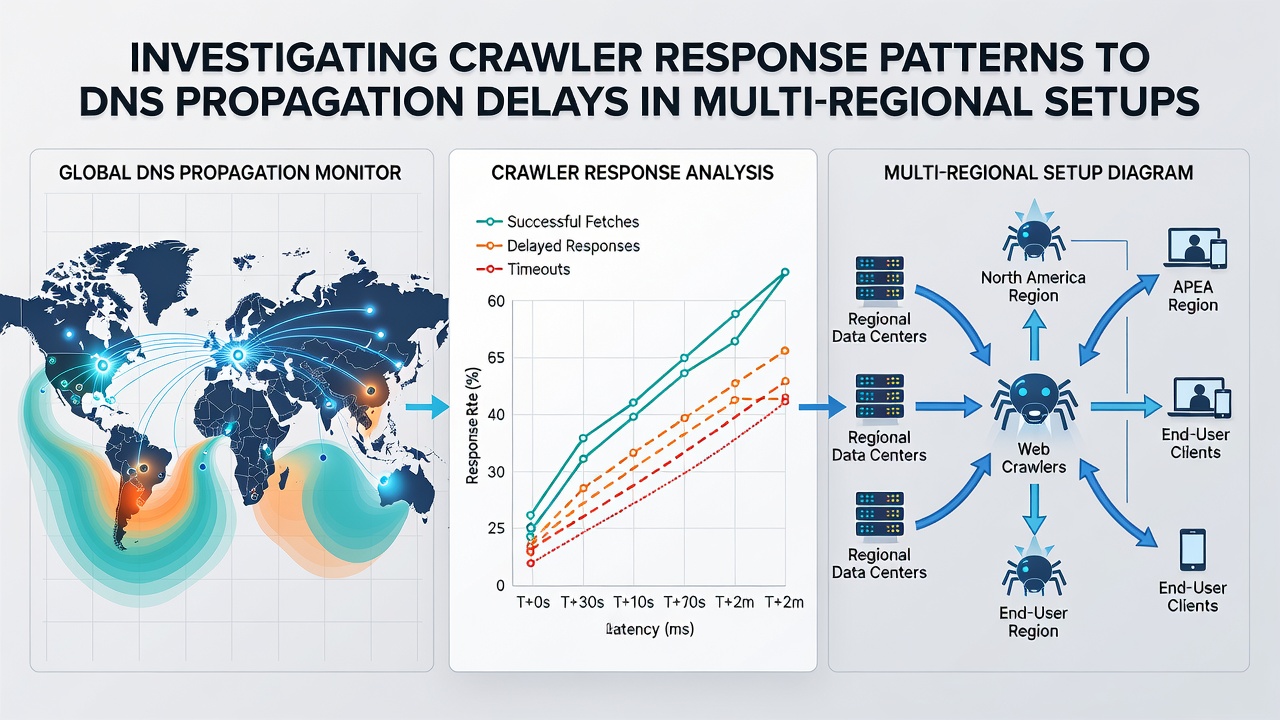
Patterns emerge most clearly when teams correlate crawl logs with DNS query traces, because discrepancies between expected and actual fetch times highlight the impact of lingering cache entries. Data shows that mobile-oriented crawlers exhibit slightly longer retry intervals than desktop-focused agents, a difference attributed to distinct infrastructure allocation rather than any deliberate policy.
Factors Influencing Regional Variation
Network congestion, resolver software versions, and peering arrangements all contribute to uneven propagation speeds, and organizations that maintain detailed resolver inventories find that older software releases retain entries longer even when TTL values have expired. Reports from RIPE NCC document how certain European transit providers apply additional rate limiting during high-volume change periods, which further stretches the time before crawlers receive consistent answers.
Anycast deployments help contain delays within specific catchment areas, yet they also create edge cases where a crawler routed to one anycast node receives fresh data while another node still serves stale records. This split-brain effect appears most frequently during partial network outages or maintenance windows that affect only a subset of global nodes.
Implications for Indexing Timelines
Indexing pipelines that depend on timely content retrieval experience downstream effects when DNS resolution stretches across hours instead of minutes, and teams that monitor both DNS and crawl metrics report corresponding delays in new URL discovery for affected domains. Canadian Internet Registration Authority analyses of .ca domains confirm that sites experiencing propagation windows longer than 90 minutes show temporary drops in crawl frequency until resolution stabilizes across all tested regions.
Additional research from APNIC Labs tracks how DNSSEC validation failures compound propagation issues in certain Asia-Pacific resolver populations, resulting in extended retry sequences that push successful crawls into subsequent days.
Conclusion
Investigations into crawler responses to DNS propagation delays continue to rely on coordinated measurement across multiple regions, and the resulting datasets provide clearer pictures of how resolution inconsistencies translate into indexing variability. Continued refinement of resolver policies and anycast strategies offers pathways to narrower delay windows, while ongoing telemetry from both DNS and crawl infrastructures supplies the raw material for identifying remaining friction points in multi-regional environments.